← Insights
Angle Drilling in Exploration: Why Inclined Holes Matter
Many orebodies dip steeply. Drilling at an angle crosses them properly and gives truer widths. What it takes from the rig.
NIKHI GROUP · 11 November 2026
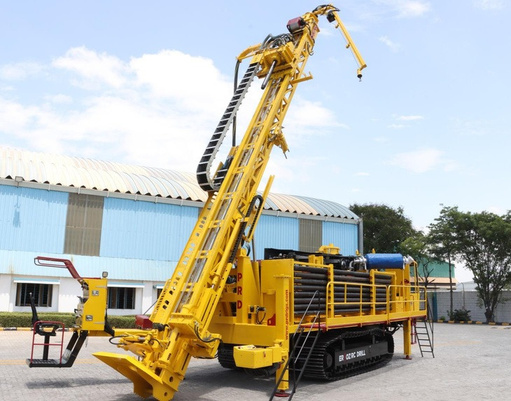
A vertical hole is not always the best way to test an orebody. In many deposits, including vein-hosted and shear-hosted gold common in West Africa, mineralised zones dip steeply. Drilling at an angle makes the hole cross them more effectively.
Why angle matters
- A hole drilled roughly perpendicular to a structure crosses it over a shorter length, giving intercepts closer to the true width.
- A vertical hole in a steep zone can run along it, overstating its width, or miss it entirely.
- Inclined holes can test a structure at depth from a convenient surface position.
What angle drilling asks of the rig
- A mast that can be set and locked at the planned angle. The PRD OZ RC drills from 45° to 90°, with manual locks in 5° increments, and raises its mast with two hydraulic cylinders with a dumping arrangement for angle drilling.
- Safe rod handling when the mast is inclined: the PRD OZ RC has a jib boom arm for this, plus radio-remote rod handling.
- Stable set-up: four hydraulic levelling jacks.
Planning tips
- Set azimuth and dip from the geological model before mobilisation.
- Build pad layouts around the hole orientation.
- Plan downhole surveys: the PRD OZ RC has a survey winch (500 kg hoisting capacity, 400 m drum).
Planning an angled RC programme? See the RC drilling page and request a quote below.
Rental quote
Request a rig rental quote
Tell us about your project and we'll reply with availability, the right configuration and pricing.