RC Drilling Explained: A Beginner's Guide for Mining Companies
What reverse-circulation drilling is, how the rig and sampling system work, what it's used for, and what to ask before you rent an RC rig.
NIKHI GROUP · 16 November 2026
Reverse-circulation (RC) drilling is one of the most common methods in mineral exploration. If you're new to it, or explaining it to a board or an investor, here is the essentials in plain language.
The idea in one sentence
Compressed air drives a hammer at the bottom of the hole, and returns the broken rock to surface inside the drill rods, where it's collected as a sample for every metre drilled.
The main parts
- Dual-wall rods: air goes down between the outer and inner tube; cuttings come back up the inner tube.
- Hammer and bit: break the rock at the bottom of the hole.
- Compressor: supplies the high-pressure air that drives the hammer and lifts the cuttings.
- Cyclone and splitter: slow the air-and-rock stream, collect the cuttings and split each interval into a lab sample.
- The rig: mast, feed system and rotary head that push, pull and turn the rods.
What RC is used for
- Testing exploration targets and defining resources
- Grade control ahead of mining
- Large programmes where cost per metre matters
RC compared with other methods
RC gives rock chips, not intact core. When geologists need intact rock for structure or metallurgical tests, they use diamond core for those holes. See RC or diamond core?.
What a modern RC rig looks like
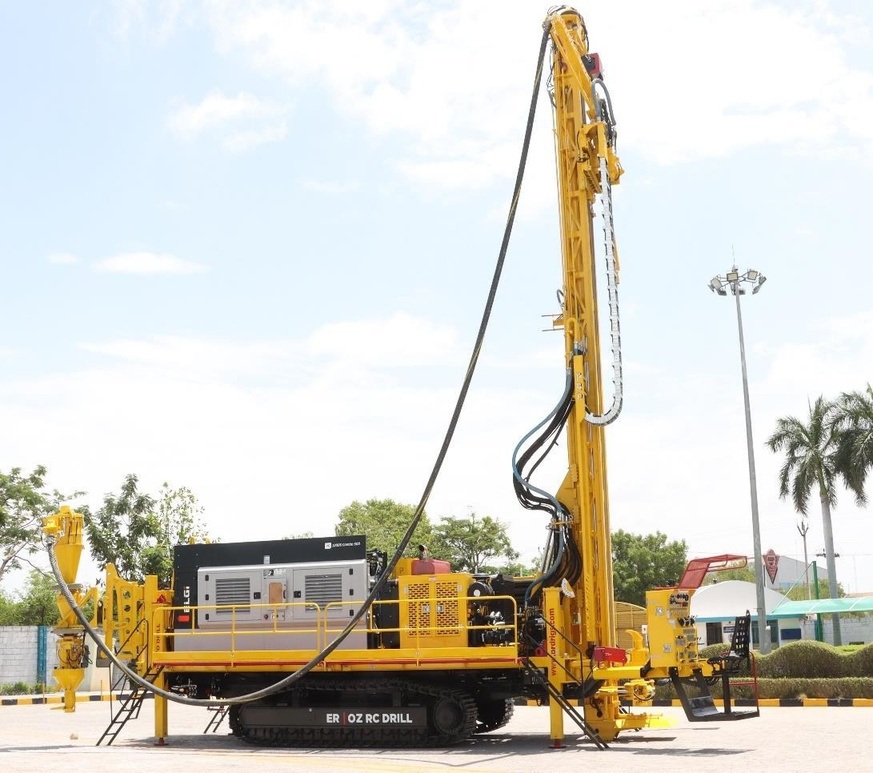
Our PRD OZ RC, available to rent now, has:
- 450 m RC capacity and 140 mm holes
- 25,800 kgf pull-up force
- drilling from 45° to 90°
- a cyclone with a static cone splitter
- radio-remote rod handling
It can be crawler- or truck-mounted.
Before you rent
Know your target depth, hole angle, metres, site location and start date. Our quote checklist lists everything to send. Then use the form below.
Rental quote
Request a rig rental quote
Tell us about your project and we'll reply with availability, the right configuration and pricing.